
Transcript
Dr. Turck:
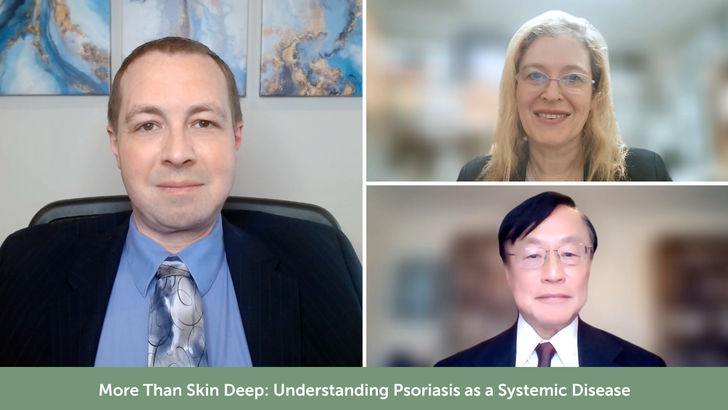
This is DermConsult on ReachMD, and I'm Dr. Charles Turck. Joining me to explore the chronic systemic inflammatory nature of psoriasis are Dr. Jenny Murase and Dr. John Koo. Dr. Murase is Associate Clinical Professor of Dermatology at the University of California, San Francisco and the Director of Medical Consultative Dermatology and Patch Testing at Palo Alto Medical Foundation in Mountain View, California. Dr. Murase, thanks for being here today.
Dr. Murase:
Thank you for having me.
Dr. Turck:
And Dr. Koo is dual board-certified in dermatology and psychiatry, and he’s the Director of the UCSF Psoriasis and Skin Treatment Center. Dr. Koo, it's great to have you with us as well.
Dr. Koo:
Thank you for having me.
Dr. Turck:
Starting with you, Dr. Koo, we used to think of psoriasis as a keratinocyte problem localized to the skin. What's changed in our understanding of the immune pathway that tells us this is a systemic process rather than a local one?
Dr. Koo:
Well, over the years, we have realized that psoriasis is not just a skin thing. There's so many comorbidities that have been associated—diabetes, depression, metabolic syndrome, obesity, and cardiovascular risk. Even for somebody with mild psoriasis, their risk of heart attack may be increased.
We are also understanding from the mental perspective that the psoriasis brain may be different than in people without psoriasis. So both physically and mentally, I think we are getting to the point where we can really appreciate the systemic inflammation and its importance.
Dr. Turck:
And Dr. Murase, I’m wondering if you could tell us a little bit about the physical comorbidities associated with psoriasis in your patients and what those tell us about the systemic nature of this disease?
Dr. Murase:
I think that is a good question because it really speaks to how the onus is on us as the dermatology provider to really see the patient holistically. I think that the tendency is, because of the time pressure we're under, which I understand because I also see 35 patients a day with systemic disease on biologics and it's very time pressured, you want to do what maximizes the benefit to that individual. And so I always have the staff asking these questions before I come into the visit so that I'm capturing that component of the systemic illness that could manifest.
So for example, the risk of arthritis for a patient that's coming in for with chronic plaque psoriasis never plateaus. So it's important to be asking about joint disease. Ask about uveitis and eye symptoms. Inflammatory bowel disease will have screening questions regarding that to capture that component.
Every year, I make sure that all of my patients with chronic plaque psoriasis have a lipid panel. I think that that's important for every dermatology provider to be doing because I've had 35-year-old patients with chronic plaque psoriasis get a myocardial infarction. I just recently had a 50-year-old have a CABG because of the cardiovascular disease. So we really need to think about how we can be good stewards of that patient to make sure that it's not just the biologic we're prescribing and running out of the room, but that we really make sure that the whole patient is addressed during that visit.
Dr. Turck:
Now, beyond the comorbidities themselves, Dr. Murase, what does living with years of unchecked systemic inflammation actually mean for a patient in terms of cumulative risk or disease trajectory over the long term?
Dr. Murase:
Well, we're talking about diseases that are inflammatory that also result in destruction, right? So I had a gentleman who was told he had eczema on his palm, and I patch tested him, and it was negative. And then he appeared a few years later. He had lost insurance and was unable to come in. He got insurance again, came back, and had a severe malformation on his hand, to the point that it was really difficult for him to even oppose with his thumb because of the fact that the arthritis had affected him from the psoriasis.
So I think we're really starting to see inflammatory disease very differently now that we have access to the therapeutics that we have. We're able to distinguish between forms of dermatitis and forms of psoriasis in ways that we weren't able to in the past because we now have ways to suppress just Th2 inflammation alone, to suppress Th17 alone, or to understand that we're going to have to suppress 1, 2, and 17 and do immunosuppression in order to get the disease under control. And of course, psoriasis is speaking to the Th17 component only, but I think it's an exciting time to be practicing because we do have these therapeutics that address portions of the immune system as opposed to just sort of a sledgehammer.
Dr. Turck:
For those just joining us, this is DermConsult on ReachMD. I'm Dr. Charles Turck, and I'm speaking with Drs. Jenny Murase and John Koo about recognizing psoriasis as a systemic inflammatory condition.
So let's take a closer look at what this all means for psoriasis care. Dr. Koo, how does treating psoriasis with today's systemic understanding differ from how clinicians might have approached it 15 or even 10 years ago?
Dr. Koo:
About 10 to 15 years ago, there was still prevalent thinking that psoriasis is just a skin thing and all you need is something that's treating from outside, such as topical creams, ointment, or phototherapy. But now we understand that with psoriasis, the inflammation involves the entire body. And this is where topical therapy took the more supplementary role for people with especially more generalized psoriasis, where the main treatment today is recognized as systemic as opposed to creams and ointments or even phototherapy.
Now, we are beginning to find that the mental comorbidities of psoriasis might actually be intimately related to systemic inflammation. This is one area that most dermatologists might have never heard of, but there is a cytokine theory of psoriasis and depression and anxiety. And what that means is that the same process and same inflammatory chemicals that push psoriasis to flare may also be responsible for depression and anxiety. Now, as a psychiatrist, I was fascinated that the cytokines that are very important for psoriasis—TNF-alpha, interleukin-17, and interleukin-23—are also very important for psychiatry for depression and anxiety. If they do not come down in the peripheral blood, it means their depression might be treatment-resistant to antidepressant. So even though biologics cannot cross the blood-brain barrier because it's too big, these cytokines and chemicals that initiate and promote inflammation can go all over the body and in and out of the brain.
Dr. Murase:
I love this because what Dr. Koo is describing really is a paradigm shift in the way that we are approaching the patient with psoriasis. I've done 7,000 consults for the dermatologists and allergists of the Bay Area over 20 years, and I used to see, just as he was describing, rashes, psoriasis, and eczemas to be within the skin, and now I know they really exist in the immune system, and the immune system affects so many different organ systems. We really are thinking about patients very differently, and that is to the patient's benefit.
Dr. Turck:
Now, given the comorbidities we've discussed earlier, Dr. Murase, how does that picture shape the therapeutic decisions you make and how you monitor patients over time?
Dr. Murase:
I do think to some degree because if we think of it as systemic inflammation as opposed to, “let's just put a topical here,” then it affects us in terms of, as I mentioned earlier, the questions that we ask in order to be able to capture that systemic component. But we also may be more likely to use systemic therapy now than we were in the past because we are thinking of it as a whole-body disease.
So I may have a patient with maybe a fairly body surface limited psoriasis who also, upon further questioning, has their joints affected and maybe some morning stiffness in their hands. Another good question is to ask about heel pain because that captures enthesitis. So I'll say, "Does it, does it feel like ever you're walking on a shard of glass?" And that will help to capture that potential for an inflammatory component of their, their arthritis. Or I may notice that they do have metabolic syndrome, and, I might be making recommendations not only for the biologic for their psoriasis, but I might actually be making weight loss recommendations with a GLP-1 in order to address their psoriasis. That is not something that I used to do before, but every day I'm in practice now, I will mention weight loss, and I did not do that before. And I certainly have mentioned cardiovascular disease in the past five to ten years as that data has been coming out. But it's going, I would say, even a further step in the way that I approach the patient.
Dr. Turck:
Before we wrap up, I'd like both of you to weigh in here. If a clinician takes just one thing away from today's conversation, what should change in how they think about and manage this disease? Dr. Koo, let's start with you.
Dr. Koo:
Well, with regard to depression and anxiety, which have always been known as comorbidities of psoriasis, one of the problems is that many dermatology providers feel nervous when the patients say, "I have psoriasis, and I'm also depressed." If somebody complains about depression and they have psoriasis, I would ask one question: "Do you think it's because of psoriasis you're depressed, or do you think psoriasis has nothing to do with your depression?" Maybe they even had depression before they developed psoriasis. And practically all the time, as you can imagine, they know that it's because of psoriasis. And if that is the case, I will be more aggressive with systemic treatment for psoriasis, not less.
Dr. Turck:
And Dr. Murase, I'll give you the final word. What should clinicians take away from this discussion about what they should change in how they think about and manage this disease?
Dr. Murase:
I really want them to understand to use their staff to capture the component of the psoriasis that is not in the skin. So have your staff be asking about the other potential systemic manifestations. At the very least, have your staff look for the lipid panel and ask about arthritis at the very minimum so that we are actually addressing the whole patient, because that's the way you save their life. You can place them on the biologic agent as a portion of the visit. But when that medical assistant went in the room and found that they hadn't had a lipid panel in five years, and it's ordered, and the cholesterol's through the roof, and they're placed on the statin, that's how you saved the patient's life. And so we need to really think about other organ systems where the potential for not catching that is actually fatal to that patient.
And so I would say the one thing that I hope in listening to this they might change within the week is when caring for that psoriasis patient, maybe asking about the eyes, asking about the gastrointestinal system, and certainly addressing the potential for the metabolic syndrome component, with cholesterol and cardiovascular disease to be addressed during that visit.
Dr. Turck:
Such important considerations. And I want to thank my guests, Drs. Jenny Murase and John Koo, for joining me to share their perspectives on the systemic nature of psoriasis. Dr. Murase, Dr. Koo, it was great having you both on the program.
Dr. Murase:
Thank you so much for having me.
Dr. Koo:
Yeah, thank you for having me here.
Dr. Turck:
You’ve been listening to DermConsult. To access this and other episodes in our series, visit DermConsult on ReachMD.com, where you can Be Part of the Knowledge. Thanks for listening!


